Visual Book Summary

Start With Why

How great leaders inspire everyone to take action.

Based on the book by Simon Sinek

“People don’t buy what you do; they buy why you do it.”
Scroll to explore
Golden Circle Diagram

The Golden Circle

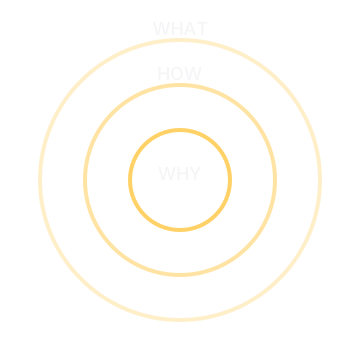
Most organizations communicate from the outside in: they talk about what they do, then how they do it. Great leaders reverse the order. They start with WHY—their purpose, cause, or belief.

  • WHY: The purpose, cause, or belief.
  • HOW: The principles and methods that bring the WHY to life.
  • WHAT: The products, services, and results.

When you start with WHY, you speak to the part of the brain that drives decisions and loyalty. The WHAT becomes proof of what you believe.
Golden Circle Diagram

Start from the center (WHY) and move outward.
Core Idea 1 – Start With WHY

The WHY is your reason for existing beyond making money. It is the belief that drives you and the contribution you want to make.

  • WHY creates meaning and direction.
  • WHY attracts people who believe what you believe.
  • WHY turns customers into loyal advocates.
  • WHY is the foundation of inspiring leadership.

Example: Apple’s WHY is about challenging the status quo and empowering creativity—not just selling computers.

Reflection

If you stripped away your job title and products, what belief would still remain?

Action

Write one sentence that expresses why you do what you do.

Core Idea 2 – HOW

HOWs are the principles, values, and methods that make your WHY tangible. They are the way you behave when you are at your best.

  • HOWs translate belief into consistent action.
  • HOWs differentiate you from others with similar WHATs.
  • HOWs create trust when they are lived consistently.

Example: If your WHY is “empower people to grow,” your HOWs might include radical transparency, coaching-first leadership, and continuous learning rituals.

Action

List 3 behaviors that express your WHY in your daily work.

Core Idea 3 – WHAT

WHATs are the products, services, and results that people can see and touch. They are the evidence of your WHY and HOW.

  • WHATs are easy to describe but not enough to inspire.
  • WHATs must align with your WHY to feel authentic.
  • WHATs are how the world experiences your purpose.

Example: A company whose WHY is “help people feel confident” might offer clothing, courses, or coaching—different WHATs, same WHY.

Action

Identify one product or service that best expresses your WHY. How could you make that alignment even clearer?

Manipulations vs. Inspiration

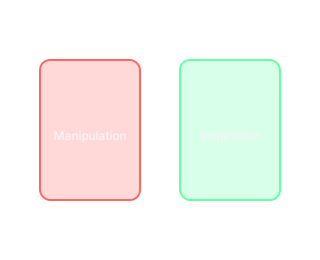
Most organizations rely on manipulations to drive behavior: discounts, fear, promotions, pressure, or scarcity. These tactics work in the short term but erode trust over time.

Inspired organizations do the opposite. They communicate a belief that resonates emotionally. This creates loyalty, not just transactions.

  • Manipulations create transactions; inspiration creates loyalty.
  • Manipulations require increasing intensity to maintain results.
  • Inspiration scales naturally because people spread beliefs they share.

Example: TiVo had a revolutionary product but no clear WHY. Their marketing focused on features, not belief — and adoption stalled.

Manipulations vs Inspiration

Inspiration builds loyalty; manipulation only buys transactions.

The Celery Test

When you know your WHY, decisions become clearer. The Celery Test is a metaphor: if your belief is about healthy living, you buy celery — not cookies — even if others recommend them.

Your WHY becomes a filter. It helps you choose the right partners, products, strategies, and opportunities.

  • Your WHY determines what belongs in your “shopping cart.”
  • It prevents distraction and misalignment.
  • It creates consistency others can see and trust.

Example: Southwest Airlines’ WHY is “democratize the skies.” Every decision — from no assigned seating to low-cost operations — aligns with that belief.

Celery Test Icon

Your WHY filters your decisions.

Split Happens

As organizations grow, the founders’ clarity of purpose often fades. New leaders focus on metrics, efficiency, or competition — and the WHY drifts.

When the WHY becomes unclear, WHAT and HOW take over. The organization becomes competent but uninspiring.

  • Growth creates distance from the original purpose.
  • New hires may not share the founder’s belief.
  • Success can cause complacency and loss of clarity.

Example: Walmart’s founder Sam Walton believed in serving people. After his death, the company drifted toward cost-cutting at all costs — losing trust and culture.

Reflection

What systems can you create to protect your WHY as you grow?

The Biology of WHY

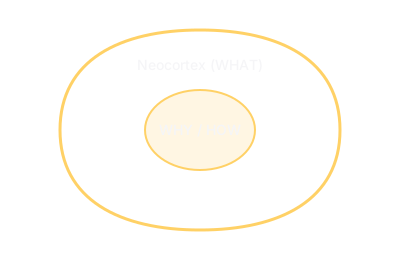
The outer circle (WHAT) corresponds to the neocortex—the part of the brain responsible for rational thought and language.

The inner circles (WHY and HOW) correspond to the limbic brain, which governs feelings, trust, and decision-making but has no capacity for language.

We often make decisions emotionally (from the inside) and then justify them with logic (from the outside).

Brain Diagram

WHY speaks to the emotional brain; WHAT speaks to the rational brain.

Trust, Authenticity, and Consistency

Trust is built when WHAT you do is consistent with WHY you say you exist. When your actions match your beliefs, people feel safe following you.

  • Clarity of WHY.
  • Discipline of HOW.
  • Consistency of WHAT.

When any of these are missing, your message feels confusing or manipulative, and trust erodes.

Reflection

Where is there a gap between what you say you believe and what you actually do?

The Law of Diffusion of Innovation

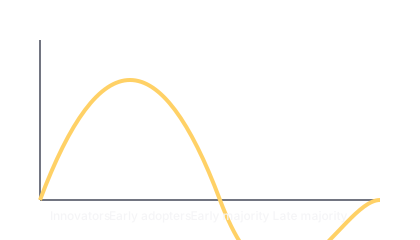
New ideas spread through a population in stages: innovators, early adopters, early majority, late majority, and laggards.

To reach a tipping point, you must first win over those who are driven by belief—the innovators and early adopters who resonate with your WHY.

When enough of them commit, the idea crosses the chasm and becomes attractive to the more pragmatic majority.

Diffusion of Innovation Curve

Focus on those who believe what you believe; they help you cross the chasm.

Examples of WHY in Action

Apple

WHY: Challenge the status quo and empower creativity.
HOW: Beautiful design, simplicity, user-first engineering.
WHAT: Computers, phones, software.

Southwest Airlines

WHY: Democratize the skies.
HOW: Low-cost operations, no-frills service.
WHAT: Affordable flights.

Harley-Davidson

WHY: Freedom and rebellion.
HOW: Loud engines, rugged design, strong community.
WHAT: Motorcycles.

The Wright Brothers

WHY: Solve the problem of human flight.
HOW: Tireless experimentation, learning from failure.
WHAT: The first successful airplane.

Martin Luther King Jr.

WHY: A world where all people are equal.
HOW: Nonviolent resistance, moral clarity.
WHAT: Speeches, marches, civil rights leadership.

Leadership That Inspires

Leadership is not about authority or rank. It is about having a clear WHY and the courage to live and communicate it consistently.

  • Leaders start with WHY and communicate from the inside out.
  • They attract people who share their beliefs.
  • They create movements, not just transactions.
Leadership Icon

Inspiring leaders give people a cause to belong to, not just a job to do.

Apply WHY to Your Life and Work

Daily Practices

  • Start meetings by restating the WHY behind the work.
  • Use WHY as a filter for major decisions.
  • Celebrate behaviors that express your WHY.
  • Regularly revisit and refine your WHY statement.

Reflection Questions

  • What belief drives the work I do?
  • Where am I acting from WHAT instead of WHY?
  • Who naturally resonates with my WHY?

Micro-Challenge (3 Days)

For the next three days, begin every important conversation or decision by stating your WHY first. Notice how it changes the tone and clarity.

Your WHY Is Your Anchor

When you lead with WHY, you attract people who believe what you believe. You create trust, loyalty, and momentum. You build something bigger than products — you build a cause.

Every great movement in history began with a clear WHY. Your work, leadership, and life can too.

Back to top